A Hardin County firefighter was critically injured and lost an arm, while a truck driver suffered minor injuries in a series of events that began shortly before 6:00 on Thanksgiving morning.
According to KFDM 6 News, emergency crews responded to an accident on Highway 105 just east of Sour Lake, and arrived to find that an 18-wheeler tanker truck, carrying 6,700 gallons of crude oil, had left the roadway, overturned, and then caught on fire.
Officials had to shut down the highway, and they also evacuated nearby homes.
While emergency crews were at the scene, another 18-wheeler, which wasn't involved in the incident, backed over a volunteer firefighter Kim Huckabee , who was helping to direct traffic. She was taken to Christus St. Elizabeth Hospital in Beaumont where doctors had to amputate her left arm near the elbow. At last word, she remained in critical condition.
According to the Texas Department of Public Safety, the driver of the tanker truck may have fallen asleep at the wheel.
Story and photograph courtsey of KJAS Radio.
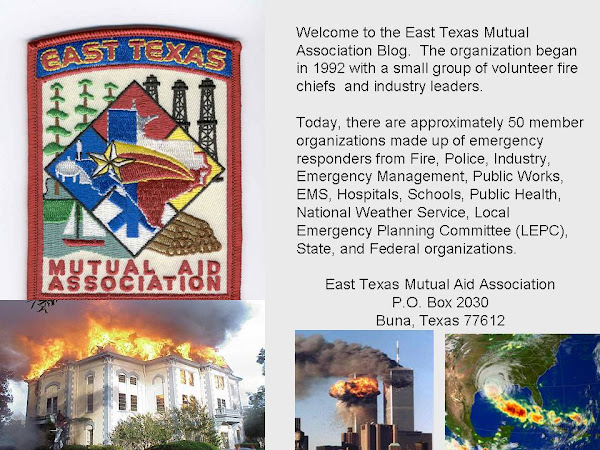
Welcome to the Homepage of the East Texas Mutual Association. The organization began in 1992 with a small group of volunteer fire chiefs and industry leaders. Today, there are approximately 50 member organizations made up of emergency responders from Fire, Police, Industry, Emergency Management, Public Works, EMS, Hospitals, Schools, Public Health, National Weather Service, Local Emergency Planning Committee (LEPC), State, and Federal organizations.
Sunday, November 27, 2011
Tuesday, November 22, 2011
Jasper, Sabine & Tyler County End A Near Nine Month Burn Ban
Officials in Jasper County announced on Tuesday that after reviewing the amount of rain received earlier in the day a decision had been made to drop the ban on all burning in the county. The decision allows resident to burn trash and yard debris as needed and also allows individuals to have camp fires. The move comes after months of prohibiting such fires due to the extreme drought conditions that have existed. On Tuesday, Jasper and the surrounding area received anywhere from 1.36 to 1.5 inches of rainfall as a line of thunderstorms moved through the area. Officials in both Tyler and Sabine Counties also lifted the ban on burning there on Tuesday morning. The ban on burning in nearby Newton County ended last week. Citizens are urged to be aware of the dangers associated with burning.
Wednesday, October 5, 2011
ESD#1 Will Meet Thursday October 6, 2011
JASPER COUNTY
EMERGENCY SERVICES DISTRICT #1
P.O. BOX 2030
Office: 409-994-2543
BUNA, TEXAS
JASPER COUNTY
EMERGENCY SERVICES DISTRICT #1
NOTICE OF REGULAR MEETING/AGENDA
In compliance with the provisions of Chapter 551, Texas Government Code, notice is hereby given of a Regular Meeting of the Board of Emergency Services Commissioners of Jasper County Emergency Services District #1, to be held at Jasper County Sub-Courthouse (33625 US Hwy 96 South) in Buna, Texas at 6:00 PM on October 6, 2011.
The following agenda items will be discussed, considered and action taken as appropriate:
1. Call to order and establish quorum
2. Reading and approval of the minutes of the last Regular meeting.
3. Treasurer’s Report
4. Public Comment (any individual may make presentation relevant to the business of the District of not more than 3 minutes to the Board of Emergency Services Commissioners, after executing the proper form, which may be obtained from the Secretary).
5. Discussion and possible action regarding new Senate Bill 917.
6. Review and approve payment of bills.
7. Discussion and possible action on Budget Amendments
8. Discussion and possible action regarding outside audit for District and Fire Department.
9. Report of Emergency Providers in the District.
10. Executive Session to discuss matters as authorized by Texas Government Code (see below)
11. Set date and time for next regular meeting
12. Any other business that may come properly before the meeting.
13. Adjournment
Note: The Board of Commissioners reserves the right to adjourn into executive session at any time during the course of the meeting to discuss any of the matters listed above as authorized by Texas Government Code, Section 551.071 (Consultation with Attorney), 551.072 (Deliberation About Real Property), 551.073 (Deliberations about Gifts and Donations), 551.074 (Personnel Matters) and 551.076 (Deliberations about Security Devices).
Jasper County Emergency Services District #1 is committed to compliance with the Disabilities Act. Reasonable modifications and equal access to communications will be provided upon request. Please call the District at 409-994-2543, for information. Hearing impaired or speech disabled persons equipped with telecommunication devices for the deaf may call the statewide Relay Texas Program, 1-800-2988.
Billy Ted Smith
Secretary/Commissioner
Jasper County ESD #1
Posted October 31, 2011
EMERGENCY SERVICES DISTRICT #1
P.O. BOX 2030
Office: 409-994-2543
BUNA, TEXAS
JASPER COUNTY
EMERGENCY SERVICES DISTRICT #1
NOTICE OF REGULAR MEETING/AGENDA
In compliance with the provisions of Chapter 551, Texas Government Code, notice is hereby given of a Regular Meeting of the Board of Emergency Services Commissioners of Jasper County Emergency Services District #1, to be held at Jasper County Sub-Courthouse (33625 US Hwy 96 South) in Buna, Texas at 6:00 PM on October 6, 2011.
The following agenda items will be discussed, considered and action taken as appropriate:
1. Call to order and establish quorum
2. Reading and approval of the minutes of the last Regular meeting.
3. Treasurer’s Report
4. Public Comment (any individual may make presentation relevant to the business of the District of not more than 3 minutes to the Board of Emergency Services Commissioners, after executing the proper form, which may be obtained from the Secretary).
5. Discussion and possible action regarding new Senate Bill 917.
6. Review and approve payment of bills.
7. Discussion and possible action on Budget Amendments
8. Discussion and possible action regarding outside audit for District and Fire Department.
9. Report of Emergency Providers in the District.
10. Executive Session to discuss matters as authorized by Texas Government Code (see below)
11. Set date and time for next regular meeting
12. Any other business that may come properly before the meeting.
13. Adjournment
Note: The Board of Commissioners reserves the right to adjourn into executive session at any time during the course of the meeting to discuss any of the matters listed above as authorized by Texas Government Code, Section 551.071 (Consultation with Attorney), 551.072 (Deliberation About Real Property), 551.073 (Deliberations about Gifts and Donations), 551.074 (Personnel Matters) and 551.076 (Deliberations about Security Devices).
Jasper County Emergency Services District #1 is committed to compliance with the Disabilities Act. Reasonable modifications and equal access to communications will be provided upon request. Please call the District at 409-994-2543, for information. Hearing impaired or speech disabled persons equipped with telecommunication devices for the deaf may call the statewide Relay Texas Program, 1-800-2988.
Billy Ted Smith
Secretary/Commissioner
Jasper County ESD #1
Posted October 31, 2011
Tuesday, October 4, 2011
Things Are Different In Texas
Subject: THINGS ARE DIFFERENT IN TEXAS
This is a great commentary on Texas folks vs Big govt.
Here are some stories about the Tricounty fire in Montgomery, Grimes, and Waller County.
My neighbor across the road has a sister named Kenna. Memorial Day, when she saw the huge column of smoke over our homes, she left a birthday party at my neighbor’s house to meet with her friend Tara at the Baseball complex in Magnolia. She called the owner of the complex and got permission to use the warehouse there as a staging area for donations for the fire fighting effort.
They put a notice out on facebook that they were going to be taking donations on their facebook pages. That night as they were setting up tables and organizing, News 2 Houston came by and saw the activity, investigated and left with the phone numbers and a list of suggested donations.
The facebook notice propagated faster than the fire. By dawn they had 20 volunteers, bins, forklifts, and donations were pouring in. I stopped by with my pitiful little bags of nasal wash and eye wash, and was amazed. There must have been 20 trucks in the lot, offloading cases of water, pallets of Gatorade , and people lined up out the door with sacks of beef jerky, baby wipes, underwear, socks, and you name it. School buses and trailers from many counties around were there offloading supplies, students froming living chains to pass stuff into the bins for transport to the command center and staging areas. If the firefighters had requested it, it was there. What do you give the guy out there fighting the fire that might engulf your home? Anything he or she wants. Including chewing tobacco and cigarettes.
Kenna moved on to the Unified Command Post at Magnolia West High school . She looked at what the fire fighters needed, and she made calls and set it up.
Mattress Mac donated 150 beds. Two class rooms turned into barracks kept quiet and dark for rest. The CEO of HEB donated 2 semi trailers full of supplies, and sent a mobile commercial kitchen at no charge to feed all the workers, but especially our firefighters, 3 hot meals a day. An impromptu commissary was set up, anything the firefighters had requested available at no charge.
As exhausted firefighters (most of them from local VFDs with no training or experience battling wildfires) and workers came into the school after long hours of hard labor, dehydrated, hungry, covered with soot and ash, they got what they needed. They were directed through the commissary, where they got soap, eye wash and nasal spray, candy, clean socks and underwear, and then were sent off to the school locker rooms for a shower. HEB then fed them a hot meal and they got 8 hours sleep in a barracks, then another hot meal, another pass through the commissary for supplies to carry with them out to lines, including gloves, safety glasses, dust masks and snacks, and back they went.
One of the imported crew from California came into Unified Command and asked where the FEMA Powerbars and water were. He was escorted to the commissary and started through the system. He was flabbergasted. He said FEMA never did it like this. Kenna replied, ”Well, this is the way we do it in Texas.”
Fire fighting equipment needed repair? The auto shop at the High School ran 24/7 with local mechanics volunteering, students, and the firefighters fixing the equipment.
Down one side of the school, the water tankers lined up at the fire hydrants and filled with water. Down the other side there was a steady parade of gasoline tankers filling trucks, dozers, tankers, cans, chain saws, and vehicles.
Mind you, all of this was set up by 2 Moms, Kenna and Tara, with a staff of 20 simple volunteers, most of them women who had sons, daughters, husbands, and friends on the fire lines. Someone always knew someone who could get what they needed- beds, mechanics, food, space. Local people using local connections to mobilize local resources made this happen. No government aid. No Trained Expert.
At one point the fire was less than a mile from the school, and everyone but hose volunteers were evacuated. The fire was turned.
The Red Cross came in, looked at what they were doing, and quietly went away to set up a fire victim relief center nearby. They said they couldn’t do it any better.
FEMA came in and told those volunteers and Kenna that they had to leave, FEMA was here now. Kenna told them she worked for the firefighters, not them. They were obnoxious, bossy, got in the way, and criticized everything. The volunteers refused to back down and kept doing their job, and doing it well. Next FEMA said the HEB supplies and kitchen had to go, that was blatant commercialism. Kenna said they stayed. They stayed. FEMA threw a wall eyed fit about chewing tobacco and cigarettes being available in the commissary area. Kenna told them the firefighters had requested it, and it was staying. It stayed. FEMA got very nasty and kept asking what organization these volunteers belonged to- and all the volunteers told them “Our community”. FEMA didn’t like that and demanded they make up a name for themselves. One mother remarked “They got me at my boiling point!” and suddenly the group was “212 Degrees”. FEMA’s contribution? They came in the next day with red shirts embroidered with “212 Degrees”, insisting the volunteers had to be identified, never realizing it was a slap in their face. Your tax dollars at work- labeling volunteers with useless shirts and getting in the way.
The upshot? A fire that the experts from California (for whom we are so grateful there are no words) said would take 2-3 weeks to get under control was 100% contained in 8 days. There was so much equipment and supplies donated, 3 container trucks are loaded with the excess to go and set up a similar relief center for the fire fighters in Bastrop. The local relief agencies have asked people to stop bringing in donations of clothing, food, household items, and pretty much everything else because they only have 60 displaced households to care for, and there is enough to supply hundreds. Again, excess is going to be shipped to Bastrop, where there are 1500 displaced households. Wish we could send Kenna, too, but she has to go back to her regular job.
~~~~~~~~~~~~~~~~~~
This is a great commentary on Texas folks vs Big govt.
Here are some stories about the Tricounty fire in Montgomery, Grimes, and Waller County.
My neighbor across the road has a sister named Kenna. Memorial Day, when she saw the huge column of smoke over our homes, she left a birthday party at my neighbor’s house to meet with her friend Tara at the Baseball complex in Magnolia. She called the owner of the complex and got permission to use the warehouse there as a staging area for donations for the fire fighting effort.
They put a notice out on facebook that they were going to be taking donations on their facebook pages. That night as they were setting up tables and organizing, News 2 Houston came by and saw the activity, investigated and left with the phone numbers and a list of suggested donations.
The facebook notice propagated faster than the fire. By dawn they had 20 volunteers, bins, forklifts, and donations were pouring in. I stopped by with my pitiful little bags of nasal wash and eye wash, and was amazed. There must have been 20 trucks in the lot, offloading cases of water, pallets of Gatorade , and people lined up out the door with sacks of beef jerky, baby wipes, underwear, socks, and you name it. School buses and trailers from many counties around were there offloading supplies, students froming living chains to pass stuff into the bins for transport to the command center and staging areas. If the firefighters had requested it, it was there. What do you give the guy out there fighting the fire that might engulf your home? Anything he or she wants. Including chewing tobacco and cigarettes.
Kenna moved on to the Unified Command Post at Magnolia West High school . She looked at what the fire fighters needed, and she made calls and set it up.
Mattress Mac donated 150 beds. Two class rooms turned into barracks kept quiet and dark for rest. The CEO of HEB donated 2 semi trailers full of supplies, and sent a mobile commercial kitchen at no charge to feed all the workers, but especially our firefighters, 3 hot meals a day. An impromptu commissary was set up, anything the firefighters had requested available at no charge.
As exhausted firefighters (most of them from local VFDs with no training or experience battling wildfires) and workers came into the school after long hours of hard labor, dehydrated, hungry, covered with soot and ash, they got what they needed. They were directed through the commissary, where they got soap, eye wash and nasal spray, candy, clean socks and underwear, and then were sent off to the school locker rooms for a shower. HEB then fed them a hot meal and they got 8 hours sleep in a barracks, then another hot meal, another pass through the commissary for supplies to carry with them out to lines, including gloves, safety glasses, dust masks and snacks, and back they went.
One of the imported crew from California came into Unified Command and asked where the FEMA Powerbars and water were. He was escorted to the commissary and started through the system. He was flabbergasted. He said FEMA never did it like this. Kenna replied, ”Well, this is the way we do it in Texas.”
Fire fighting equipment needed repair? The auto shop at the High School ran 24/7 with local mechanics volunteering, students, and the firefighters fixing the equipment.
Down one side of the school, the water tankers lined up at the fire hydrants and filled with water. Down the other side there was a steady parade of gasoline tankers filling trucks, dozers, tankers, cans, chain saws, and vehicles.
Mind you, all of this was set up by 2 Moms, Kenna and Tara, with a staff of 20 simple volunteers, most of them women who had sons, daughters, husbands, and friends on the fire lines. Someone always knew someone who could get what they needed- beds, mechanics, food, space. Local people using local connections to mobilize local resources made this happen. No government aid. No Trained Expert.
At one point the fire was less than a mile from the school, and everyone but hose volunteers were evacuated. The fire was turned.
The Red Cross came in, looked at what they were doing, and quietly went away to set up a fire victim relief center nearby. They said they couldn’t do it any better.
FEMA came in and told those volunteers and Kenna that they had to leave, FEMA was here now. Kenna told them she worked for the firefighters, not them. They were obnoxious, bossy, got in the way, and criticized everything. The volunteers refused to back down and kept doing their job, and doing it well. Next FEMA said the HEB supplies and kitchen had to go, that was blatant commercialism. Kenna said they stayed. They stayed. FEMA threw a wall eyed fit about chewing tobacco and cigarettes being available in the commissary area. Kenna told them the firefighters had requested it, and it was staying. It stayed. FEMA got very nasty and kept asking what organization these volunteers belonged to- and all the volunteers told them “Our community”. FEMA didn’t like that and demanded they make up a name for themselves. One mother remarked “They got me at my boiling point!” and suddenly the group was “212 Degrees”. FEMA’s contribution? They came in the next day with red shirts embroidered with “212 Degrees”, insisting the volunteers had to be identified, never realizing it was a slap in their face. Your tax dollars at work- labeling volunteers with useless shirts and getting in the way.
The upshot? A fire that the experts from California (for whom we are so grateful there are no words) said would take 2-3 weeks to get under control was 100% contained in 8 days. There was so much equipment and supplies donated, 3 container trucks are loaded with the excess to go and set up a similar relief center for the fire fighters in Bastrop. The local relief agencies have asked people to stop bringing in donations of clothing, food, household items, and pretty much everything else because they only have 60 displaced households to care for, and there is enough to supply hundreds. Again, excess is going to be shipped to Bastrop, where there are 1500 displaced households. Wish we could send Kenna, too, but she has to go back to her regular job.
~~~~~~~~~~~~~~~~~~
Thursday, January 13, 2011
Citywide power outage planned for February
According to Tommy Boykin, City Manager, the City of Jasper will experience a planned power outage on Sunday February 13, 2011 from 11:00 p.m. to 3:00 a.m.
Boykin said the outage is necessary due to a faulty main switch that must be replaced in the 138,000 volt Jason electrical substation on Milam Street.
Boykin said that there is simply no way to replace the switch without shutting off all power and that after considerable discussion it was decided that black out will take place on the Sunday evening while most people are asleep.
Boykin said that local citizens should remember that the outage will mean that all traffic lights, street lights and other lights will be out.
Boykin said that over the next few weeks residents, especially those with special needs should be making plans for the outage. However, he also said that the Jasper Fire Department, which has emergency power on Water Street will be open and would serve as a shelter for those who want to go there.
City officials have said that in the case of a hard freeze or cold weather, the outage will be postponed.
Boykin said the outage is necessary due to a faulty main switch that must be replaced in the 138,000 volt Jason electrical substation on Milam Street.
Boykin said that there is simply no way to replace the switch without shutting off all power and that after considerable discussion it was decided that black out will take place on the Sunday evening while most people are asleep.
Boykin said that local citizens should remember that the outage will mean that all traffic lights, street lights and other lights will be out.
Boykin said that over the next few weeks residents, especially those with special needs should be making plans for the outage. However, he also said that the Jasper Fire Department, which has emergency power on Water Street will be open and would serve as a shelter for those who want to go there.
City officials have said that in the case of a hard freeze or cold weather, the outage will be postponed.
Wednesday, January 5, 2011
ETMA January Meeting
The next meeting of the East Texas Mutual Aid Association will be held on Thursday January 20 at 7:00 PM.
The Evadale VFD will host this months meeting at their station on Hwy 105 in Evadale.
Please make your plans now to attend.
The Evadale VFD will host this months meeting at their station on Hwy 105 in Evadale.
Please make your plans now to attend.
Tuesday, December 21, 2010
Christmas Light Safety
Christmas lights are beautiful and much safer than candles, but all that electricity can cause problems if not used properly. Christmas lights can get hot enough to burn or ignite other decorations. The cords can fray, leading to a short. Decorating with lights often requires the use of a ladder, and improper use could lead to an injury. Practice ladder safety when you are putting up Christmas lights.
When you put up Christmas lights this season - or holiday lights during any season - be sure to follow these Christmas light safety tips.
Choose Christmas lights that have been tested and deemed safe by a reputable testing laboratory, the best are UL or ETL. Christmas lights listed as safe by these laboratories will note that on the packaging.
Try to use the cooler-burning "mini" Christmas lights as opposed to the traditional larger bulbs. The older style burns much hotter.
Only use Christmas lights that have fuses in the plugs.
Inspect each set of Christmas lights - old or new - for damage. Return or throw out any set with cracked or broken sockets, frayed or bare wires, or loose connections.
Replace burned out bulbs promptly with bulbs of the same wattage.
Never hang Christmas lights on a metal tree. The tree can become charged with electricity and shock someone. The tree can also short out the Christmas lights and cause a fire.
Want Christmas lights outdoors? Use outdoor Christmas lights. The packaging will note whether the lights can be used indoors, outdoors, or both.
All outdoor electrical decorations should be plugged into a ground-fault circuit interrupter (GFCI). You can buy portable units for outdoor use, or you can have them permanently installed by an electrician.
Use extension cords properly. Outdoor cords can be used inside or outside. Do not overload extension cords - they can get hot enough to burn.
Stay away from powerlines or feeder lines (these go from the pole to the house).
Secure outside Christmas lights with insulated holders (never use tacks or nails) or run strings of lights through hooks.
When you leave or go to bed at night, turn off your Christmas lights.
Never pull on a string of Christmas lights, it stresses the cords and can lead to fraying. Store Christmas lights loosely wrapped for the same reason.
When you put up Christmas lights this season - or holiday lights during any season - be sure to follow these Christmas light safety tips.
Choose Christmas lights that have been tested and deemed safe by a reputable testing laboratory, the best are UL or ETL. Christmas lights listed as safe by these laboratories will note that on the packaging.
Try to use the cooler-burning "mini" Christmas lights as opposed to the traditional larger bulbs. The older style burns much hotter.
Only use Christmas lights that have fuses in the plugs.
Inspect each set of Christmas lights - old or new - for damage. Return or throw out any set with cracked or broken sockets, frayed or bare wires, or loose connections.
Replace burned out bulbs promptly with bulbs of the same wattage.
Never hang Christmas lights on a metal tree. The tree can become charged with electricity and shock someone. The tree can also short out the Christmas lights and cause a fire.
Want Christmas lights outdoors? Use outdoor Christmas lights. The packaging will note whether the lights can be used indoors, outdoors, or both.
All outdoor electrical decorations should be plugged into a ground-fault circuit interrupter (GFCI). You can buy portable units for outdoor use, or you can have them permanently installed by an electrician.
Use extension cords properly. Outdoor cords can be used inside or outside. Do not overload extension cords - they can get hot enough to burn.
Stay away from powerlines or feeder lines (these go from the pole to the house).
Secure outside Christmas lights with insulated holders (never use tacks or nails) or run strings of lights through hooks.
When you leave or go to bed at night, turn off your Christmas lights.
Never pull on a string of Christmas lights, it stresses the cords and can lead to fraying. Store Christmas lights loosely wrapped for the same reason.
Wednesday, August 18, 2010
ETMA AUGUST MEETING
Remember East Texas Mutual Aid Association meeting Thursday night 7:00 PM. This month's meeting hosted by Tri-Community VFD at Magnolia Springs.
Monday, August 2, 2010
ICS-300 ICS FOR EXPANDING INCIDENTS
Jasper/Newton/Sabine Counties Emergency Management/Homeland Security will host the following course on August 23 and 24. In order to register for the class, it will be necessary for you to go to the Texas Department of Public Safety "Preparing Texas" website at https://www.preparingtexas.org/ and sign up on your account. If you do not have an account it will be necessary to set up one.
The Intermediate ICS for Expanding Incidents course provides training on and resources for personnel who require advanced application of the ICS. The course expands upon information covered in the ICS-100 and ICS-200 courses.
Prerequisites:
All of the following are required:
• IS-700: Introduction to NIMS
• ICS-100: Introduction to ICS
• ICS-200: Basic ICS
Cost:
No tuition is charged.
Class Name: ICS-300: Intermediate Incident Command System for Expanding Incidents
Course Number: G-300
Date Span: 8/23/2010 - 8/24/2010
Class Times: 08/23 08:00 - 17:00
08/24 08:00 - 17:00
Location: Jasper Fire Department
205 Water
JASPER, TX 75951
County: JASPER
Instructor: Smith, Billy - Lead Instructor
Joe Wilkinson - Adjunct Instructor
Olen Bean - Adjunct Instructor
Provider: TDEM - Emergency Management Training
Point of Contact: Smith, Billy
Jasper County
409-994-2543
billy.smith@co.jasper.tx.us
Hours: 18.00
Provider: TDEM - Emergency Management Training
Sponsor: TDEM
Disciplines: Emergency Management
Emergency Medical Service
Fire Service
Government Administration
Hazmat
Health Care
Law Enforcement
Public Health
Public Safety Communications
Public Works
We suggest you register as soon as possible because training spaces are limited. This course is limited to only 25 students and will partisipants will be selected on "first come basis" and jurisdictional needs and is open statewide.
This course is also TCLEOS approved.
The Intermediate ICS for Expanding Incidents course provides training on and resources for personnel who require advanced application of the ICS. The course expands upon information covered in the ICS-100 and ICS-200 courses.
Prerequisites:
All of the following are required:
• IS-700: Introduction to NIMS
• ICS-100: Introduction to ICS
• ICS-200: Basic ICS
Cost:
No tuition is charged.
Class Name: ICS-300: Intermediate Incident Command System for Expanding Incidents
Course Number: G-300
Date Span: 8/23/2010 - 8/24/2010
Class Times: 08/23 08:00 - 17:00
08/24 08:00 - 17:00
Location: Jasper Fire Department
205 Water
JASPER, TX 75951
County: JASPER
Instructor: Smith, Billy - Lead Instructor
Joe Wilkinson - Adjunct Instructor
Olen Bean - Adjunct Instructor
Provider: TDEM - Emergency Management Training
Point of Contact: Smith, Billy
Jasper County
409-994-2543
billy.smith@co.jasper.tx.us
Hours: 18.00
Provider: TDEM - Emergency Management Training
Sponsor: TDEM
Disciplines: Emergency Management
Emergency Medical Service
Fire Service
Government Administration
Hazmat
Health Care
Law Enforcement
Public Health
Public Safety Communications
Public Works
We suggest you register as soon as possible because training spaces are limited. This course is limited to only 25 students and will partisipants will be selected on "first come basis" and jurisdictional needs and is open statewide.
This course is also TCLEOS approved.
Monday, July 26, 2010
newton CERT'S Team Graduate
Newton CERT completes eight week committment to training and dedication. This brings the Jasper, Newton and Sabine Counties Emergency Management's CERT team to 60 volunteers. Congratulation and thanks for your dedication
Sunday, July 4, 2010
Saturday, June 26, 2010
Tropical Storm Alex
These graphics show probabilities of sustained (1-minute average) surface wind speeds equal to or exceeding 34 kt...39 mph (tropical storm force). These wind speed probability graphics are based on the official National Hurricane Center (NHC) track, intensity, and wind radii forecasts, and on NHC forecast error statistics for those forecast variables during recent years. Each graphic provides cumulative probabilities that wind speeds of at least 39 mph will occur during cumulative time periods at each specific point on the map. The cumulative periods begin at the start of the forecast period and extend through the entire 5-day forecast period at cumulative 12-hour intervals (i.e., 0-12 h, 0-24 h, 0-36 h, ... , 0-120 h). An individual graphic is produced for each cumulative interval, and the capability to zoom and animate through the periods is provided. To assess the overall risk of experiencing winds of at least 39 mph at any location, the 120-h graphics are recommended.
These probabilities will be updated by the NHC with each advisory package for all active tropical cyclones in the Atlantic and eastern North Pacific basins. While separate graphics are focused on each individual tropical cyclone, probabilities resulting from more than one active tropical cyclone may be seen on each graphic.
Additionally, these probability products are available on the National Weather Service's National Digital Forecast Database (NDFD) graphical tropical webpage.
The previously provided strike probability product (discontinued after 2005) conveyed the chances of a "close" approach of the center of the cyclone. However, these new probability products are about the weather. That is, these cumulative wind speed probabilities provide the chances that wind speeds of at least 39 mph will occur at individual locations. The cumulative probabilities can answer the question, "What are the chances that sustained winds of tropical storm or hurricane force will occur at any specific location?" This can also help one answer the question, "Do I need to take certain actions to prepare?" A companion product, the wind speed probability text product, will also be issued and updated with each advisory package. That product is recommended to more easily assess when winds of each threshold are most likely to start at any specific location, helping to answer the question, "How long do I have to prepare?" Overall, these probabilities provide users with information that can enhance their ability to make preparedness decisions specific to their own situations.
It is important for users to realize that wind speed probabilities that might seem relatively small at their location might still be quite significant, since they indicate that there is a chance that a damaging or even extreme event could occur that warrants preparations to protect lives and property.
Friday, June 25, 2010
Tropical Depression #1 Forms
The first tropical depression of the 2010 season has formed.
This graphic shows an approximate representation of coastal areas under a hurricane warning (red), hurricane watch (pink), tropical storm warning (blue) and tropical storm watch (yellow). The orange circle indicates the current position of the center of the tropical cyclone. The black line, when selected, and dots show the National Hurricane Center (NHC) forecast track of the center at the times indicated. The dot indicating the forecast center location will be black if the cyclone is forecast to be tropical and will be white with a black outline if the cyclone is forecast to be extratropical. If only an L is displayed, then the system is forecast to be a remnant low. The letter inside the dot indicates the NHC's forecast intensity for that time.
NHC tropical cyclone forecast tracks can be in error. This forecast uncertainty is conveyed by the track forecast "cone", the solid white and stippled white areas in the graphic. The solid white area depicts the track forecast uncertainty for days 1-3 of the forecast, while the stippled area depicts the uncertainty on days 4-5. Historical data indicate that the entire 5-day path of the center of the tropical cyclone will remain within the cone about 60-70% of the time. To form the cone, a set of imaginary circles are placed along the forecast track at the 12, 24, 36, 48, 72, 96, and 120 h positions, where the size of each circle is set so that it encloses 67% of the previous five years official forecast errors. The cone is then formed by smoothly connecting the area swept out by the set of circles.
There is also uncertainty in the NHC intensity forecasts. The Maximum 1-minute Wind Speed Probability Table provides intensity forecast and uncertainty information.
It is also important to realize that a tropical cyclone is not a point. Their effects can span many hundreds of miles from the center. The area experiencing hurricane force (one-minute average wind speeds of at least 74 mph) and tropical storm force (one-minute average wind speeds of 39-73 mph) winds can extend well beyond the white areas shown enclosing the most likely track area of the center. The distribution of hurricane and tropical storm force winds in this tropical cyclone can be seen in the Wind History graphic linked above.
Considering the combined forecast uncertainties in track, intensity, and size, the chances that any particular location will experience winds of 34 kt (tropical storm force), 50 kt, or 64 kt (hurricane force) from this tropical cyclone are presented in tabular form for selected locations and forecast positions. This information is also presented in graphical form for the 34 kt, 50 kt, and 64 kt thresholds.
Wednesday, June 23, 2010
Wednesday, June 16, 2010
June ETMA Meeting
Remember East Texas Mutual Aid Association meeting Thursday night (June 17) at 7 PM. The meeting will be hosted by Kirbyville Fire Department and be helld at the JNEC building (812 South Margaret St.) in Kirbyville
Friday, June 11, 2010
DPS Director Appoints Interim Chief of Emergency Management
Friday, June 11, 2010 0
San Antonio District Fire Chief W. Nim Kidd has been named as the interim chief of the Texas Division of Emergency Management starting July 1, 2010. Chief Kidd replaces Jack Colley, who suffered a fatal heart attack last month.
Kidd’s appointment was made by Steven C. McCraw, director of the Texas Department of Public Safety, with the concurrence of Governor Rick Perry and Allan Polunsky, chairman of the Texas Public Safety Commission.
“Jack Colley was a national icon in emergency management, a man whose invaluable service saved countless lives in Texas and established a legacy of competence that will be felt for years to come,” Director McCraw said. “As we enter the 2010 Hurricane Season, we are fortunate to welcome Chief Kidd, an experienced leader in handling disasters in our state, whose skills and dedication will keep Texas a national leader in emergency preparedness and management.”
Chief Kidd is currently San Antonio’s Homeland Security Director, managing the Homeland Security Grant Program, and is chair of the Urban Area Security Initiative Working Group. Kidd has also served as the city’s Emergency Manager since 2004, managing the city’s preparedness, response and recovery efforts for all local disasters, including more than a dozen substantial disasters impacting the community.
Kidd has worked with the San Antonio Fire Department (SAFD) since 1993, holding the rank of firefighter, fire apparatus operator, lieutenant, captain, and District Fire Chief. He has led the SAFD Technical Rescue Team and the Hazardous Material Response Team.
Additionally, Kidd has served as a member of Texas Task Force 1 Urban Search and Rescue Team since 1997, responding to state and national disasters including the World Trade Center attack in September 2001. Chief Kidd holds the Certified Emergency Manager designation from the International Association of Emergency Managers and has served as a member of the Board of Directors of the Emergency Management Association of Texas. Chief Kidd currently serves on the Governor’s Emergency Medical Services and Trauma Advisory Council-Disaster Committee, and the Governor’s Texas Preparedness Advisory Council for the Texas Division of Emergency Management.
San Antonio District Fire Chief W. Nim Kidd has been named as the interim chief of the Texas Division of Emergency Management starting July 1, 2010. Chief Kidd replaces Jack Colley, who suffered a fatal heart attack last month.
Kidd’s appointment was made by Steven C. McCraw, director of the Texas Department of Public Safety, with the concurrence of Governor Rick Perry and Allan Polunsky, chairman of the Texas Public Safety Commission.
“Jack Colley was a national icon in emergency management, a man whose invaluable service saved countless lives in Texas and established a legacy of competence that will be felt for years to come,” Director McCraw said. “As we enter the 2010 Hurricane Season, we are fortunate to welcome Chief Kidd, an experienced leader in handling disasters in our state, whose skills and dedication will keep Texas a national leader in emergency preparedness and management.”
Chief Kidd is currently San Antonio’s Homeland Security Director, managing the Homeland Security Grant Program, and is chair of the Urban Area Security Initiative Working Group. Kidd has also served as the city’s Emergency Manager since 2004, managing the city’s preparedness, response and recovery efforts for all local disasters, including more than a dozen substantial disasters impacting the community.
Kidd has worked with the San Antonio Fire Department (SAFD) since 1993, holding the rank of firefighter, fire apparatus operator, lieutenant, captain, and District Fire Chief. He has led the SAFD Technical Rescue Team and the Hazardous Material Response Team.
Additionally, Kidd has served as a member of Texas Task Force 1 Urban Search and Rescue Team since 1997, responding to state and national disasters including the World Trade Center attack in September 2001. Chief Kidd holds the Certified Emergency Manager designation from the International Association of Emergency Managers and has served as a member of the Board of Directors of the Emergency Management Association of Texas. Chief Kidd currently serves on the Governor’s Emergency Medical Services and Trauma Advisory Council-Disaster Committee, and the Governor’s Texas Preparedness Advisory Council for the Texas Division of Emergency Management.
Monday, June 7, 2010
DPS troopers checking 18-wheeler safety June 8-10
During RoadCheck 2010, law enforcement agencies across the United States, Mexico and Canada will be checking commercial motor vehicles such as 18-wheelers. The 72-hour intensive inspection program runs from June 8 through 10 throughout North America.
DPS Commercial Vehicle Enforcement troopers and noncommissioned inspectors, along with Highway Patrol troopers who have received specialized training in commercial vehicle inspection, will stop thousands of commercial vehicles to inspect safety equipment and check driver log books, driver licenses and endorsements. Inspectors will also look for possible drug or alcohol use.
“We want to emphasize to all commercial vehicle operators traveling through Texas that safety is our foremost concern. We’ll be looking for trucks and drivers who aren’t complying with safety requirements, and we’ll place them out of service if necessary,” said David Baker, the assistant director who oversees the Texas Highway Patrol.
During Roadcheck 2009, DPS inspectors examined 7,316 vehicles in Texas. As a result, troopers removed 1,636 vehicles and 202 drivers from service because of the serious nature of their safety violations. Inspectors placed 125 drivers out of service for hours-of-service violations. Other violations ranged from false log violations, having the improper endorsement to suspended, expired and cancelled licenses. Seven drivers were placed out of service for drug or alcohol violations. Troopers issued 12 tickets for seat belt violations.
The Roadcheck program, which stretches from Mexico to Canada, is designed to reduce commercial vehicle highway fatalities through increased vehicle safety. The Commercial Vehicle Safety Alliance (CVSA), which sponsors Roadcheck, reports a significant decrease in the commercial vehicle crash rate in North America since the program’s start in 1988.
Vehicles passing inspection receive a CVSA decal exempting the vehicle from inspection for a 90-day period, unless they have an obvious safety defect. DPS troopers issued 3,037 decals during Roadcheck 2009.
DPS Commercial Vehicle Enforcement troopers and noncommissioned inspectors, along with Highway Patrol troopers who have received specialized training in commercial vehicle inspection, will stop thousands of commercial vehicles to inspect safety equipment and check driver log books, driver licenses and endorsements. Inspectors will also look for possible drug or alcohol use.
“We want to emphasize to all commercial vehicle operators traveling through Texas that safety is our foremost concern. We’ll be looking for trucks and drivers who aren’t complying with safety requirements, and we’ll place them out of service if necessary,” said David Baker, the assistant director who oversees the Texas Highway Patrol.
During Roadcheck 2009, DPS inspectors examined 7,316 vehicles in Texas. As a result, troopers removed 1,636 vehicles and 202 drivers from service because of the serious nature of their safety violations. Inspectors placed 125 drivers out of service for hours-of-service violations. Other violations ranged from false log violations, having the improper endorsement to suspended, expired and cancelled licenses. Seven drivers were placed out of service for drug or alcohol violations. Troopers issued 12 tickets for seat belt violations.
The Roadcheck program, which stretches from Mexico to Canada, is designed to reduce commercial vehicle highway fatalities through increased vehicle safety. The Commercial Vehicle Safety Alliance (CVSA), which sponsors Roadcheck, reports a significant decrease in the commercial vehicle crash rate in North America since the program’s start in 1988.
Vehicles passing inspection receive a CVSA decal exempting the vehicle from inspection for a 90-day period, unless they have an obvious safety defect. DPS troopers issued 3,037 decals during Roadcheck 2009.
USA, TX, TEXAS CITY, MAY 6 2010. BP: 500,000 POUNDS OF EMISSIONS RELEASED
At BP’s Texas City refinery, more than 400 pounds a day of benzene — 40 times the state reportable levels — was released during a 40-day period while a subunit of the refinery’s ultracracker unit was offline, according to a company filing with the state’s environmental agency Friday. In all, BP officials said more than 500,000 pounds of pollutants and nonpollutants were released while the company increased flaring as they tried to repair a compressor on the faulty unit. Refinery spokesman Michael Marr said in its follow up reporting with the Texas Commission on Environmental Quality, BP estimated 36,000 pounds of nitrogen oxides and 17,000 pounds of benzene were released in the 40 days. State law requires 10 pounds or more of benzene and 200 pounds or more of nitrogen oxide during a 24-hour period must be reported through the commission’s air emissions database. Benzene is a carcinogen naturally found in oil that has been linked to some forms of cancer, according to U.S. Health and Human Services records. Nitrogen oxides react to sunlight to form ozone and can damage lung tissue and cause respiratory problems. However, neither of the levels of the emissions reached levels that required self-reporting to the U.S. Environmental Protection Agency, Marr said. The EPA requires any nitrogen oxides release of more than 1,000 pounds a day be reported, while the federal agency does not require reports of benzene emissions. According to BP’s filing with the TCEQ, the ultracracker’s hydrogen compressor went offline April 6 and was not repaired or restarted until May 16. Because of the malfunction, the subunit was shut down, and materials were purged and gasses were rerouted to a flare, according to the company’s filing. The ultracracker, which remained operable, can process 65,000 barrels of oil per day and mostly produces high-octane blending components for gasoline. The ultracracker also can produce ethane, propane, butane, pentane, hexane and distillate. The bulk of the emissions during that time included an estimated 189,000 pounds of carbon monoxide and 61,000 pounds of propane, according to the company’s report to the TCEQ. “During this time period, the site’s fenceline monitoring did not indicate any excess readings,” Marr said. “Also of note, the site performed modeling of the emissions using TCEQ-approved modeling methods, and that modeling did not indicate an exceedance of regulatory exposure limits to workers or the community at any time during the flaring.” TCEQ spokeswoman Andrea Morrow said the filing starts a process that includes a review by the agency that could end up before the commission’s enforcement division. She said depending on why and what caused the emissions, the agency could take enforcement action. But without knowing the specifics of the BP emissions, she could not comment on what action the agency could or would take. She did caution the figures BP included in its report likely were estimates that will be higher than what actually was released. She said companies that underreport emissions face penalties. So the companies often will “shoot high,” Morrow said. According to BP’s TCEQ filing, all of the figures were estimates.
Benzene Emissions
According to a 2008 report by the Environmental Integrity Project, BP’s Texas City refinery was among four refineries in the nation that had the largest increases in benzene emissions even as overall benzene emissions among U.S. refiners decreased by more than 18 percent between 2000 and 2008. The environmental group claims refiners actually underreport how much of the carcinogen is released because of inadequate EPA standards. However, according to a report to the Texas City-La Marque Community Advisory Council by the Galveston County Health District’s director of Environmental Health last summer, benzene emissions in Texas City decreased by 74 percent between 1993 and 2008. That report does not single out BP nor attribute how much each of the city’s chemical plants or refineries reduced benzene emissions.
Source: Environmental Integrity Project, Texas City-La Marque Community Advisory Council
Benzene Emissions
According to a 2008 report by the Environmental Integrity Project, BP’s Texas City refinery was among four refineries in the nation that had the largest increases in benzene emissions even as overall benzene emissions among U.S. refiners decreased by more than 18 percent between 2000 and 2008. The environmental group claims refiners actually underreport how much of the carcinogen is released because of inadequate EPA standards. However, according to a report to the Texas City-La Marque Community Advisory Council by the Galveston County Health District’s director of Environmental Health last summer, benzene emissions in Texas City decreased by 74 percent between 1993 and 2008. That report does not single out BP nor attribute how much each of the city’s chemical plants or refineries reduced benzene emissions.
Source: Environmental Integrity Project, Texas City-La Marque Community Advisory Council
Tuesday, June 1, 2010
Subject: Revised Hurricane Response Plan Emergency
The following announces the recent revision to the State of Texas Hurricane Response Plan, dated April 30, 2010, and request your assistance in distributing the information. The revised documents are located on the TDEM website:
http://www.txdps.state.tx.us/dem/pages/downloadableforms.htm#hurrevac.
Summary of Changes
- The document was renamed Hurricane Response Plan to more accurately reflect the operational construct of the plan.
- The basic plan was revised to include revisions to the hurricane response organization, protocols, and operations.
- It incorporates and/or partially incorporates recent legislative changes to Government Code, Chapter 418. The TDEM Plans Unit continues to revise other state planning documents to fully incorporate these requirements. Changes to this plan include:
o Legal authorities granted to the Governor and Emergency Management Directors during a Mandatory Evacuation.
o DEM name change to TDEM.
o Provisions to replenish food supplies of food banks or pantries.
o Provides for the initial response after a disaster, reentry, and transition to the program of recovery.
o Better incorporates the integration of volunteer groups into emergency plans and encourages the public to participate in volunteer emergency teams that respond to disasters.
o Defines individuals with special needs.
o Enhanced medical special needs categories, requirements for medical special needs and minimum health-related standards for shelters operated with state funds. These requirements will be further developed during the revisions of State Annex H, Health and Medical, and Annex C, Shelter and Mass Care.
o Establishes a phased reentry plan that accommodates local plans and local official preferences with respect to reentry.
o Addresses license portability, post disaster evaluations and seizure of State or federal resource restrictions.
- The Disaster District Traffic Management Plans were revised and include the new district area identifiers.
- The Plan includes new attachments addressing the Special Needs Tracking System, Reentry Task Forces, Reentry Plan, Commodity Distribution Plan, and Fuel Operations Plan.
http://www.txdps.state.tx.us/dem/pages/downloadableforms.htm#hurrevac.
Summary of Changes
- The document was renamed Hurricane Response Plan to more accurately reflect the operational construct of the plan.
- The basic plan was revised to include revisions to the hurricane response organization, protocols, and operations.
- It incorporates and/or partially incorporates recent legislative changes to Government Code, Chapter 418. The TDEM Plans Unit continues to revise other state planning documents to fully incorporate these requirements. Changes to this plan include:
o Legal authorities granted to the Governor and Emergency Management Directors during a Mandatory Evacuation.
o DEM name change to TDEM.
o Provisions to replenish food supplies of food banks or pantries.
o Provides for the initial response after a disaster, reentry, and transition to the program of recovery.
o Better incorporates the integration of volunteer groups into emergency plans and encourages the public to participate in volunteer emergency teams that respond to disasters.
o Defines individuals with special needs.
o Enhanced medical special needs categories, requirements for medical special needs and minimum health-related standards for shelters operated with state funds. These requirements will be further developed during the revisions of State Annex H, Health and Medical, and Annex C, Shelter and Mass Care.
o Establishes a phased reentry plan that accommodates local plans and local official preferences with respect to reentry.
o Addresses license portability, post disaster evaluations and seizure of State or federal resource restrictions.
- The Disaster District Traffic Management Plans were revised and include the new district area identifiers.
- The Plan includes new attachments addressing the Special Needs Tracking System, Reentry Task Forces, Reentry Plan, Commodity Distribution Plan, and Fuel Operations Plan.
Subscribe to:
Posts (Atom)
Sunday, November 27, 2011
Firefighter critically injured after tanker truck accident in Hardin County
A Hardin County firefighter was critically injured and lost an arm, while a truck driver suffered minor injuries in a series of events that began shortly before 6:00 on Thanksgiving morning.
According to KFDM 6 News, emergency crews responded to an accident on Highway 105 just east of Sour Lake, and arrived to find that an 18-wheeler tanker truck, carrying 6,700 gallons of crude oil, had left the roadway, overturned, and then caught on fire.
Officials had to shut down the highway, and they also evacuated nearby homes.
While emergency crews were at the scene, another 18-wheeler, which wasn't involved in the incident, backed over a volunteer firefighter Kim Huckabee , who was helping to direct traffic. She was taken to Christus St. Elizabeth Hospital in Beaumont where doctors had to amputate her left arm near the elbow. At last word, she remained in critical condition.
According to the Texas Department of Public Safety, the driver of the tanker truck may have fallen asleep at the wheel.
Story and photograph courtsey of KJAS Radio.
According to KFDM 6 News, emergency crews responded to an accident on Highway 105 just east of Sour Lake, and arrived to find that an 18-wheeler tanker truck, carrying 6,700 gallons of crude oil, had left the roadway, overturned, and then caught on fire.
Officials had to shut down the highway, and they also evacuated nearby homes.
While emergency crews were at the scene, another 18-wheeler, which wasn't involved in the incident, backed over a volunteer firefighter Kim Huckabee , who was helping to direct traffic. She was taken to Christus St. Elizabeth Hospital in Beaumont where doctors had to amputate her left arm near the elbow. At last word, she remained in critical condition.
According to the Texas Department of Public Safety, the driver of the tanker truck may have fallen asleep at the wheel.
Story and photograph courtsey of KJAS Radio.
Tuesday, November 22, 2011
Jasper, Sabine & Tyler County End A Near Nine Month Burn Ban
Officials in Jasper County announced on Tuesday that after reviewing the amount of rain received earlier in the day a decision had been made to drop the ban on all burning in the county. The decision allows resident to burn trash and yard debris as needed and also allows individuals to have camp fires. The move comes after months of prohibiting such fires due to the extreme drought conditions that have existed. On Tuesday, Jasper and the surrounding area received anywhere from 1.36 to 1.5 inches of rainfall as a line of thunderstorms moved through the area. Officials in both Tyler and Sabine Counties also lifted the ban on burning there on Tuesday morning. The ban on burning in nearby Newton County ended last week. Citizens are urged to be aware of the dangers associated with burning.
Wednesday, October 5, 2011
ESD#1 Will Meet Thursday October 6, 2011
JASPER COUNTY
EMERGENCY SERVICES DISTRICT #1
P.O. BOX 2030
Office: 409-994-2543
BUNA, TEXAS
JASPER COUNTY
EMERGENCY SERVICES DISTRICT #1
NOTICE OF REGULAR MEETING/AGENDA
In compliance with the provisions of Chapter 551, Texas Government Code, notice is hereby given of a Regular Meeting of the Board of Emergency Services Commissioners of Jasper County Emergency Services District #1, to be held at Jasper County Sub-Courthouse (33625 US Hwy 96 South) in Buna, Texas at 6:00 PM on October 6, 2011.
The following agenda items will be discussed, considered and action taken as appropriate:
1. Call to order and establish quorum
2. Reading and approval of the minutes of the last Regular meeting.
3. Treasurer’s Report
4. Public Comment (any individual may make presentation relevant to the business of the District of not more than 3 minutes to the Board of Emergency Services Commissioners, after executing the proper form, which may be obtained from the Secretary).
5. Discussion and possible action regarding new Senate Bill 917.
6. Review and approve payment of bills.
7. Discussion and possible action on Budget Amendments
8. Discussion and possible action regarding outside audit for District and Fire Department.
9. Report of Emergency Providers in the District.
10. Executive Session to discuss matters as authorized by Texas Government Code (see below)
11. Set date and time for next regular meeting
12. Any other business that may come properly before the meeting.
13. Adjournment
Note: The Board of Commissioners reserves the right to adjourn into executive session at any time during the course of the meeting to discuss any of the matters listed above as authorized by Texas Government Code, Section 551.071 (Consultation with Attorney), 551.072 (Deliberation About Real Property), 551.073 (Deliberations about Gifts and Donations), 551.074 (Personnel Matters) and 551.076 (Deliberations about Security Devices).
Jasper County Emergency Services District #1 is committed to compliance with the Disabilities Act. Reasonable modifications and equal access to communications will be provided upon request. Please call the District at 409-994-2543, for information. Hearing impaired or speech disabled persons equipped with telecommunication devices for the deaf may call the statewide Relay Texas Program, 1-800-2988.
Billy Ted Smith
Secretary/Commissioner
Jasper County ESD #1
Posted October 31, 2011
EMERGENCY SERVICES DISTRICT #1
P.O. BOX 2030
Office: 409-994-2543
BUNA, TEXAS
JASPER COUNTY
EMERGENCY SERVICES DISTRICT #1
NOTICE OF REGULAR MEETING/AGENDA
In compliance with the provisions of Chapter 551, Texas Government Code, notice is hereby given of a Regular Meeting of the Board of Emergency Services Commissioners of Jasper County Emergency Services District #1, to be held at Jasper County Sub-Courthouse (33625 US Hwy 96 South) in Buna, Texas at 6:00 PM on October 6, 2011.
The following agenda items will be discussed, considered and action taken as appropriate:
1. Call to order and establish quorum
2. Reading and approval of the minutes of the last Regular meeting.
3. Treasurer’s Report
4. Public Comment (any individual may make presentation relevant to the business of the District of not more than 3 minutes to the Board of Emergency Services Commissioners, after executing the proper form, which may be obtained from the Secretary).
5. Discussion and possible action regarding new Senate Bill 917.
6. Review and approve payment of bills.
7. Discussion and possible action on Budget Amendments
8. Discussion and possible action regarding outside audit for District and Fire Department.
9. Report of Emergency Providers in the District.
10. Executive Session to discuss matters as authorized by Texas Government Code (see below)
11. Set date and time for next regular meeting
12. Any other business that may come properly before the meeting.
13. Adjournment
Note: The Board of Commissioners reserves the right to adjourn into executive session at any time during the course of the meeting to discuss any of the matters listed above as authorized by Texas Government Code, Section 551.071 (Consultation with Attorney), 551.072 (Deliberation About Real Property), 551.073 (Deliberations about Gifts and Donations), 551.074 (Personnel Matters) and 551.076 (Deliberations about Security Devices).
Jasper County Emergency Services District #1 is committed to compliance with the Disabilities Act. Reasonable modifications and equal access to communications will be provided upon request. Please call the District at 409-994-2543, for information. Hearing impaired or speech disabled persons equipped with telecommunication devices for the deaf may call the statewide Relay Texas Program, 1-800-2988.
Billy Ted Smith
Secretary/Commissioner
Jasper County ESD #1
Posted October 31, 2011
Tuesday, October 4, 2011
Things Are Different In Texas
Subject: THINGS ARE DIFFERENT IN TEXAS
This is a great commentary on Texas folks vs Big govt.
Here are some stories about the Tricounty fire in Montgomery, Grimes, and Waller County.
My neighbor across the road has a sister named Kenna. Memorial Day, when she saw the huge column of smoke over our homes, she left a birthday party at my neighbor’s house to meet with her friend Tara at the Baseball complex in Magnolia. She called the owner of the complex and got permission to use the warehouse there as a staging area for donations for the fire fighting effort.
They put a notice out on facebook that they were going to be taking donations on their facebook pages. That night as they were setting up tables and organizing, News 2 Houston came by and saw the activity, investigated and left with the phone numbers and a list of suggested donations.
The facebook notice propagated faster than the fire. By dawn they had 20 volunteers, bins, forklifts, and donations were pouring in. I stopped by with my pitiful little bags of nasal wash and eye wash, and was amazed. There must have been 20 trucks in the lot, offloading cases of water, pallets of Gatorade , and people lined up out the door with sacks of beef jerky, baby wipes, underwear, socks, and you name it. School buses and trailers from many counties around were there offloading supplies, students froming living chains to pass stuff into the bins for transport to the command center and staging areas. If the firefighters had requested it, it was there. What do you give the guy out there fighting the fire that might engulf your home? Anything he or she wants. Including chewing tobacco and cigarettes.
Kenna moved on to the Unified Command Post at Magnolia West High school . She looked at what the fire fighters needed, and she made calls and set it up.
Mattress Mac donated 150 beds. Two class rooms turned into barracks kept quiet and dark for rest. The CEO of HEB donated 2 semi trailers full of supplies, and sent a mobile commercial kitchen at no charge to feed all the workers, but especially our firefighters, 3 hot meals a day. An impromptu commissary was set up, anything the firefighters had requested available at no charge.
As exhausted firefighters (most of them from local VFDs with no training or experience battling wildfires) and workers came into the school after long hours of hard labor, dehydrated, hungry, covered with soot and ash, they got what they needed. They were directed through the commissary, where they got soap, eye wash and nasal spray, candy, clean socks and underwear, and then were sent off to the school locker rooms for a shower. HEB then fed them a hot meal and they got 8 hours sleep in a barracks, then another hot meal, another pass through the commissary for supplies to carry with them out to lines, including gloves, safety glasses, dust masks and snacks, and back they went.
One of the imported crew from California came into Unified Command and asked where the FEMA Powerbars and water were. He was escorted to the commissary and started through the system. He was flabbergasted. He said FEMA never did it like this. Kenna replied, ”Well, this is the way we do it in Texas.”
Fire fighting equipment needed repair? The auto shop at the High School ran 24/7 with local mechanics volunteering, students, and the firefighters fixing the equipment.
Down one side of the school, the water tankers lined up at the fire hydrants and filled with water. Down the other side there was a steady parade of gasoline tankers filling trucks, dozers, tankers, cans, chain saws, and vehicles.
Mind you, all of this was set up by 2 Moms, Kenna and Tara, with a staff of 20 simple volunteers, most of them women who had sons, daughters, husbands, and friends on the fire lines. Someone always knew someone who could get what they needed- beds, mechanics, food, space. Local people using local connections to mobilize local resources made this happen. No government aid. No Trained Expert.
At one point the fire was less than a mile from the school, and everyone but hose volunteers were evacuated. The fire was turned.
The Red Cross came in, looked at what they were doing, and quietly went away to set up a fire victim relief center nearby. They said they couldn’t do it any better.
FEMA came in and told those volunteers and Kenna that they had to leave, FEMA was here now. Kenna told them she worked for the firefighters, not them. They were obnoxious, bossy, got in the way, and criticized everything. The volunteers refused to back down and kept doing their job, and doing it well. Next FEMA said the HEB supplies and kitchen had to go, that was blatant commercialism. Kenna said they stayed. They stayed. FEMA threw a wall eyed fit about chewing tobacco and cigarettes being available in the commissary area. Kenna told them the firefighters had requested it, and it was staying. It stayed. FEMA got very nasty and kept asking what organization these volunteers belonged to- and all the volunteers told them “Our community”. FEMA didn’t like that and demanded they make up a name for themselves. One mother remarked “They got me at my boiling point!” and suddenly the group was “212 Degrees”. FEMA’s contribution? They came in the next day with red shirts embroidered with “212 Degrees”, insisting the volunteers had to be identified, never realizing it was a slap in their face. Your tax dollars at work- labeling volunteers with useless shirts and getting in the way.
The upshot? A fire that the experts from California (for whom we are so grateful there are no words) said would take 2-3 weeks to get under control was 100% contained in 8 days. There was so much equipment and supplies donated, 3 container trucks are loaded with the excess to go and set up a similar relief center for the fire fighters in Bastrop. The local relief agencies have asked people to stop bringing in donations of clothing, food, household items, and pretty much everything else because they only have 60 displaced households to care for, and there is enough to supply hundreds. Again, excess is going to be shipped to Bastrop, where there are 1500 displaced households. Wish we could send Kenna, too, but she has to go back to her regular job.
~~~~~~~~~~~~~~~~~~
This is a great commentary on Texas folks vs Big govt.
Here are some stories about the Tricounty fire in Montgomery, Grimes, and Waller County.
My neighbor across the road has a sister named Kenna. Memorial Day, when she saw the huge column of smoke over our homes, she left a birthday party at my neighbor’s house to meet with her friend Tara at the Baseball complex in Magnolia. She called the owner of the complex and got permission to use the warehouse there as a staging area for donations for the fire fighting effort.
They put a notice out on facebook that they were going to be taking donations on their facebook pages. That night as they were setting up tables and organizing, News 2 Houston came by and saw the activity, investigated and left with the phone numbers and a list of suggested donations.
The facebook notice propagated faster than the fire. By dawn they had 20 volunteers, bins, forklifts, and donations were pouring in. I stopped by with my pitiful little bags of nasal wash and eye wash, and was amazed. There must have been 20 trucks in the lot, offloading cases of water, pallets of Gatorade , and people lined up out the door with sacks of beef jerky, baby wipes, underwear, socks, and you name it. School buses and trailers from many counties around were there offloading supplies, students froming living chains to pass stuff into the bins for transport to the command center and staging areas. If the firefighters had requested it, it was there. What do you give the guy out there fighting the fire that might engulf your home? Anything he or she wants. Including chewing tobacco and cigarettes.
Kenna moved on to the Unified Command Post at Magnolia West High school . She looked at what the fire fighters needed, and she made calls and set it up.
Mattress Mac donated 150 beds. Two class rooms turned into barracks kept quiet and dark for rest. The CEO of HEB donated 2 semi trailers full of supplies, and sent a mobile commercial kitchen at no charge to feed all the workers, but especially our firefighters, 3 hot meals a day. An impromptu commissary was set up, anything the firefighters had requested available at no charge.
As exhausted firefighters (most of them from local VFDs with no training or experience battling wildfires) and workers came into the school after long hours of hard labor, dehydrated, hungry, covered with soot and ash, they got what they needed. They were directed through the commissary, where they got soap, eye wash and nasal spray, candy, clean socks and underwear, and then were sent off to the school locker rooms for a shower. HEB then fed them a hot meal and they got 8 hours sleep in a barracks, then another hot meal, another pass through the commissary for supplies to carry with them out to lines, including gloves, safety glasses, dust masks and snacks, and back they went.
One of the imported crew from California came into Unified Command and asked where the FEMA Powerbars and water were. He was escorted to the commissary and started through the system. He was flabbergasted. He said FEMA never did it like this. Kenna replied, ”Well, this is the way we do it in Texas.”
Fire fighting equipment needed repair? The auto shop at the High School ran 24/7 with local mechanics volunteering, students, and the firefighters fixing the equipment.
Down one side of the school, the water tankers lined up at the fire hydrants and filled with water. Down the other side there was a steady parade of gasoline tankers filling trucks, dozers, tankers, cans, chain saws, and vehicles.
Mind you, all of this was set up by 2 Moms, Kenna and Tara, with a staff of 20 simple volunteers, most of them women who had sons, daughters, husbands, and friends on the fire lines. Someone always knew someone who could get what they needed- beds, mechanics, food, space. Local people using local connections to mobilize local resources made this happen. No government aid. No Trained Expert.
At one point the fire was less than a mile from the school, and everyone but hose volunteers were evacuated. The fire was turned.
The Red Cross came in, looked at what they were doing, and quietly went away to set up a fire victim relief center nearby. They said they couldn’t do it any better.
FEMA came in and told those volunteers and Kenna that they had to leave, FEMA was here now. Kenna told them she worked for the firefighters, not them. They were obnoxious, bossy, got in the way, and criticized everything. The volunteers refused to back down and kept doing their job, and doing it well. Next FEMA said the HEB supplies and kitchen had to go, that was blatant commercialism. Kenna said they stayed. They stayed. FEMA threw a wall eyed fit about chewing tobacco and cigarettes being available in the commissary area. Kenna told them the firefighters had requested it, and it was staying. It stayed. FEMA got very nasty and kept asking what organization these volunteers belonged to- and all the volunteers told them “Our community”. FEMA didn’t like that and demanded they make up a name for themselves. One mother remarked “They got me at my boiling point!” and suddenly the group was “212 Degrees”. FEMA’s contribution? They came in the next day with red shirts embroidered with “212 Degrees”, insisting the volunteers had to be identified, never realizing it was a slap in their face. Your tax dollars at work- labeling volunteers with useless shirts and getting in the way.
The upshot? A fire that the experts from California (for whom we are so grateful there are no words) said would take 2-3 weeks to get under control was 100% contained in 8 days. There was so much equipment and supplies donated, 3 container trucks are loaded with the excess to go and set up a similar relief center for the fire fighters in Bastrop. The local relief agencies have asked people to stop bringing in donations of clothing, food, household items, and pretty much everything else because they only have 60 displaced households to care for, and there is enough to supply hundreds. Again, excess is going to be shipped to Bastrop, where there are 1500 displaced households. Wish we could send Kenna, too, but she has to go back to her regular job.
~~~~~~~~~~~~~~~~~~
Thursday, January 13, 2011
Citywide power outage planned for February
According to Tommy Boykin, City Manager, the City of Jasper will experience a planned power outage on Sunday February 13, 2011 from 11:00 p.m. to 3:00 a.m.
Boykin said the outage is necessary due to a faulty main switch that must be replaced in the 138,000 volt Jason electrical substation on Milam Street.
Boykin said that there is simply no way to replace the switch without shutting off all power and that after considerable discussion it was decided that black out will take place on the Sunday evening while most people are asleep.
Boykin said that local citizens should remember that the outage will mean that all traffic lights, street lights and other lights will be out.
Boykin said that over the next few weeks residents, especially those with special needs should be making plans for the outage. However, he also said that the Jasper Fire Department, which has emergency power on Water Street will be open and would serve as a shelter for those who want to go there.
City officials have said that in the case of a hard freeze or cold weather, the outage will be postponed.
Boykin said the outage is necessary due to a faulty main switch that must be replaced in the 138,000 volt Jason electrical substation on Milam Street.
Boykin said that there is simply no way to replace the switch without shutting off all power and that after considerable discussion it was decided that black out will take place on the Sunday evening while most people are asleep.
Boykin said that local citizens should remember that the outage will mean that all traffic lights, street lights and other lights will be out.
Boykin said that over the next few weeks residents, especially those with special needs should be making plans for the outage. However, he also said that the Jasper Fire Department, which has emergency power on Water Street will be open and would serve as a shelter for those who want to go there.
City officials have said that in the case of a hard freeze or cold weather, the outage will be postponed.
Wednesday, January 5, 2011
ETMA January Meeting
The next meeting of the East Texas Mutual Aid Association will be held on Thursday January 20 at 7:00 PM.
The Evadale VFD will host this months meeting at their station on Hwy 105 in Evadale.
Please make your plans now to attend.
The Evadale VFD will host this months meeting at their station on Hwy 105 in Evadale.
Please make your plans now to attend.
Tuesday, December 21, 2010
Christmas Light Safety
Christmas lights are beautiful and much safer than candles, but all that electricity can cause problems if not used properly. Christmas lights can get hot enough to burn or ignite other decorations. The cords can fray, leading to a short. Decorating with lights often requires the use of a ladder, and improper use could lead to an injury. Practice ladder safety when you are putting up Christmas lights.
When you put up Christmas lights this season - or holiday lights during any season - be sure to follow these Christmas light safety tips.
Choose Christmas lights that have been tested and deemed safe by a reputable testing laboratory, the best are UL or ETL. Christmas lights listed as safe by these laboratories will note that on the packaging.
Try to use the cooler-burning "mini" Christmas lights as opposed to the traditional larger bulbs. The older style burns much hotter.
Only use Christmas lights that have fuses in the plugs.
Inspect each set of Christmas lights - old or new - for damage. Return or throw out any set with cracked or broken sockets, frayed or bare wires, or loose connections.
Replace burned out bulbs promptly with bulbs of the same wattage.
Never hang Christmas lights on a metal tree. The tree can become charged with electricity and shock someone. The tree can also short out the Christmas lights and cause a fire.
Want Christmas lights outdoors? Use outdoor Christmas lights. The packaging will note whether the lights can be used indoors, outdoors, or both.
All outdoor electrical decorations should be plugged into a ground-fault circuit interrupter (GFCI). You can buy portable units for outdoor use, or you can have them permanently installed by an electrician.
Use extension cords properly. Outdoor cords can be used inside or outside. Do not overload extension cords - they can get hot enough to burn.
Stay away from powerlines or feeder lines (these go from the pole to the house).
Secure outside Christmas lights with insulated holders (never use tacks or nails) or run strings of lights through hooks.
When you leave or go to bed at night, turn off your Christmas lights.
Never pull on a string of Christmas lights, it stresses the cords and can lead to fraying. Store Christmas lights loosely wrapped for the same reason.
When you put up Christmas lights this season - or holiday lights during any season - be sure to follow these Christmas light safety tips.
Choose Christmas lights that have been tested and deemed safe by a reputable testing laboratory, the best are UL or ETL. Christmas lights listed as safe by these laboratories will note that on the packaging.
Try to use the cooler-burning "mini" Christmas lights as opposed to the traditional larger bulbs. The older style burns much hotter.
Only use Christmas lights that have fuses in the plugs.
Inspect each set of Christmas lights - old or new - for damage. Return or throw out any set with cracked or broken sockets, frayed or bare wires, or loose connections.
Replace burned out bulbs promptly with bulbs of the same wattage.
Never hang Christmas lights on a metal tree. The tree can become charged with electricity and shock someone. The tree can also short out the Christmas lights and cause a fire.
Want Christmas lights outdoors? Use outdoor Christmas lights. The packaging will note whether the lights can be used indoors, outdoors, or both.
All outdoor electrical decorations should be plugged into a ground-fault circuit interrupter (GFCI). You can buy portable units for outdoor use, or you can have them permanently installed by an electrician.
Use extension cords properly. Outdoor cords can be used inside or outside. Do not overload extension cords - they can get hot enough to burn.
Stay away from powerlines or feeder lines (these go from the pole to the house).
Secure outside Christmas lights with insulated holders (never use tacks or nails) or run strings of lights through hooks.
When you leave or go to bed at night, turn off your Christmas lights.
Never pull on a string of Christmas lights, it stresses the cords and can lead to fraying. Store Christmas lights loosely wrapped for the same reason.
Wednesday, August 18, 2010
ETMA AUGUST MEETING
Remember East Texas Mutual Aid Association meeting Thursday night 7:00 PM. This month's meeting hosted by Tri-Community VFD at Magnolia Springs.
Monday, August 2, 2010
ICS-300 ICS FOR EXPANDING INCIDENTS
Jasper/Newton/Sabine Counties Emergency Management/Homeland Security will host the following course on August 23 and 24. In order to register for the class, it will be necessary for you to go to the Texas Department of Public Safety "Preparing Texas" website at https://www.preparingtexas.org/ and sign up on your account. If you do not have an account it will be necessary to set up one.
The Intermediate ICS for Expanding Incidents course provides training on and resources for personnel who require advanced application of the ICS. The course expands upon information covered in the ICS-100 and ICS-200 courses.
Prerequisites:
All of the following are required:
• IS-700: Introduction to NIMS
• ICS-100: Introduction to ICS
• ICS-200: Basic ICS
Cost:
No tuition is charged.
Class Name: ICS-300: Intermediate Incident Command System for Expanding Incidents
Course Number: G-300
Date Span: 8/23/2010 - 8/24/2010
Class Times: 08/23 08:00 - 17:00
08/24 08:00 - 17:00
Location: Jasper Fire Department
205 Water
JASPER, TX 75951
County: JASPER
Instructor: Smith, Billy - Lead Instructor
Joe Wilkinson - Adjunct Instructor
Olen Bean - Adjunct Instructor
Provider: TDEM - Emergency Management Training
Point of Contact: Smith, Billy
Jasper County
409-994-2543
billy.smith@co.jasper.tx.us
Hours: 18.00
Provider: TDEM - Emergency Management Training
Sponsor: TDEM
Disciplines: Emergency Management
Emergency Medical Service
Fire Service
Government Administration
Hazmat
Health Care
Law Enforcement
Public Health
Public Safety Communications
Public Works
We suggest you register as soon as possible because training spaces are limited. This course is limited to only 25 students and will partisipants will be selected on "first come basis" and jurisdictional needs and is open statewide.
This course is also TCLEOS approved.
The Intermediate ICS for Expanding Incidents course provides training on and resources for personnel who require advanced application of the ICS. The course expands upon information covered in the ICS-100 and ICS-200 courses.
Prerequisites:
All of the following are required:
• IS-700: Introduction to NIMS
• ICS-100: Introduction to ICS
• ICS-200: Basic ICS
Cost:
No tuition is charged.
Class Name: ICS-300: Intermediate Incident Command System for Expanding Incidents
Course Number: G-300
Date Span: 8/23/2010 - 8/24/2010
Class Times: 08/23 08:00 - 17:00
08/24 08:00 - 17:00
Location: Jasper Fire Department
205 Water
JASPER, TX 75951
County: JASPER
Instructor: Smith, Billy - Lead Instructor
Joe Wilkinson - Adjunct Instructor
Olen Bean - Adjunct Instructor
Provider: TDEM - Emergency Management Training
Point of Contact: Smith, Billy
Jasper County
409-994-2543
billy.smith@co.jasper.tx.us
Hours: 18.00
Provider: TDEM - Emergency Management Training
Sponsor: TDEM
Disciplines: Emergency Management
Emergency Medical Service
Fire Service
Government Administration
Hazmat
Health Care
Law Enforcement
Public Health
Public Safety Communications
Public Works
We suggest you register as soon as possible because training spaces are limited. This course is limited to only 25 students and will partisipants will be selected on "first come basis" and jurisdictional needs and is open statewide.
This course is also TCLEOS approved.
Monday, July 26, 2010
newton CERT'S Team Graduate
Newton CERT completes eight week committment to training and dedication. This brings the Jasper, Newton and Sabine Counties Emergency Management's CERT team to 60 volunteers. Congratulation and thanks for your dedication
Sunday, July 4, 2010
Saturday, June 26, 2010
Tropical Storm Alex
These graphics show probabilities of sustained (1-minute average) surface wind speeds equal to or exceeding 34 kt...39 mph (tropical storm force). These wind speed probability graphics are based on the official National Hurricane Center (NHC) track, intensity, and wind radii forecasts, and on NHC forecast error statistics for those forecast variables during recent years. Each graphic provides cumulative probabilities that wind speeds of at least 39 mph will occur during cumulative time periods at each specific point on the map. The cumulative periods begin at the start of the forecast period and extend through the entire 5-day forecast period at cumulative 12-hour intervals (i.e., 0-12 h, 0-24 h, 0-36 h, ... , 0-120 h). An individual graphic is produced for each cumulative interval, and the capability to zoom and animate through the periods is provided. To assess the overall risk of experiencing winds of at least 39 mph at any location, the 120-h graphics are recommended.
These probabilities will be updated by the NHC with each advisory package for all active tropical cyclones in the Atlantic and eastern North Pacific basins. While separate graphics are focused on each individual tropical cyclone, probabilities resulting from more than one active tropical cyclone may be seen on each graphic.
Additionally, these probability products are available on the National Weather Service's National Digital Forecast Database (NDFD) graphical tropical webpage.
The previously provided strike probability product (discontinued after 2005) conveyed the chances of a "close" approach of the center of the cyclone. However, these new probability products are about the weather. That is, these cumulative wind speed probabilities provide the chances that wind speeds of at least 39 mph will occur at individual locations. The cumulative probabilities can answer the question, "What are the chances that sustained winds of tropical storm or hurricane force will occur at any specific location?" This can also help one answer the question, "Do I need to take certain actions to prepare?" A companion product, the wind speed probability text product, will also be issued and updated with each advisory package. That product is recommended to more easily assess when winds of each threshold are most likely to start at any specific location, helping to answer the question, "How long do I have to prepare?" Overall, these probabilities provide users with information that can enhance their ability to make preparedness decisions specific to their own situations.
It is important for users to realize that wind speed probabilities that might seem relatively small at their location might still be quite significant, since they indicate that there is a chance that a damaging or even extreme event could occur that warrants preparations to protect lives and property.
Friday, June 25, 2010
Tropical Depression #1 Forms
The first tropical depression of the 2010 season has formed.
This graphic shows an approximate representation of coastal areas under a hurricane warning (red), hurricane watch (pink), tropical storm warning (blue) and tropical storm watch (yellow). The orange circle indicates the current position of the center of the tropical cyclone. The black line, when selected, and dots show the National Hurricane Center (NHC) forecast track of the center at the times indicated. The dot indicating the forecast center location will be black if the cyclone is forecast to be tropical and will be white with a black outline if the cyclone is forecast to be extratropical. If only an L is displayed, then the system is forecast to be a remnant low. The letter inside the dot indicates the NHC's forecast intensity for that time.
NHC tropical cyclone forecast tracks can be in error. This forecast uncertainty is conveyed by the track forecast "cone", the solid white and stippled white areas in the graphic. The solid white area depicts the track forecast uncertainty for days 1-3 of the forecast, while the stippled area depicts the uncertainty on days 4-5. Historical data indicate that the entire 5-day path of the center of the tropical cyclone will remain within the cone about 60-70% of the time. To form the cone, a set of imaginary circles are placed along the forecast track at the 12, 24, 36, 48, 72, 96, and 120 h positions, where the size of each circle is set so that it encloses 67% of the previous five years official forecast errors. The cone is then formed by smoothly connecting the area swept out by the set of circles.
There is also uncertainty in the NHC intensity forecasts. The Maximum 1-minute Wind Speed Probability Table provides intensity forecast and uncertainty information.
It is also important to realize that a tropical cyclone is not a point. Their effects can span many hundreds of miles from the center. The area experiencing hurricane force (one-minute average wind speeds of at least 74 mph) and tropical storm force (one-minute average wind speeds of 39-73 mph) winds can extend well beyond the white areas shown enclosing the most likely track area of the center. The distribution of hurricane and tropical storm force winds in this tropical cyclone can be seen in the Wind History graphic linked above.
Considering the combined forecast uncertainties in track, intensity, and size, the chances that any particular location will experience winds of 34 kt (tropical storm force), 50 kt, or 64 kt (hurricane force) from this tropical cyclone are presented in tabular form for selected locations and forecast positions. This information is also presented in graphical form for the 34 kt, 50 kt, and 64 kt thresholds.
Wednesday, June 23, 2010
Wednesday, June 16, 2010
June ETMA Meeting
Remember East Texas Mutual Aid Association meeting Thursday night (June 17) at 7 PM. The meeting will be hosted by Kirbyville Fire Department and be helld at the JNEC building (812 South Margaret St.) in Kirbyville
Friday, June 11, 2010
DPS Director Appoints Interim Chief of Emergency Management
Friday, June 11, 2010 0
San Antonio District Fire Chief W. Nim Kidd has been named as the interim chief of the Texas Division of Emergency Management starting July 1, 2010. Chief Kidd replaces Jack Colley, who suffered a fatal heart attack last month.
Kidd’s appointment was made by Steven C. McCraw, director of the Texas Department of Public Safety, with the concurrence of Governor Rick Perry and Allan Polunsky, chairman of the Texas Public Safety Commission.
“Jack Colley was a national icon in emergency management, a man whose invaluable service saved countless lives in Texas and established a legacy of competence that will be felt for years to come,” Director McCraw said. “As we enter the 2010 Hurricane Season, we are fortunate to welcome Chief Kidd, an experienced leader in handling disasters in our state, whose skills and dedication will keep Texas a national leader in emergency preparedness and management.”
Chief Kidd is currently San Antonio’s Homeland Security Director, managing the Homeland Security Grant Program, and is chair of the Urban Area Security Initiative Working Group. Kidd has also served as the city’s Emergency Manager since 2004, managing the city’s preparedness, response and recovery efforts for all local disasters, including more than a dozen substantial disasters impacting the community.
Kidd has worked with the San Antonio Fire Department (SAFD) since 1993, holding the rank of firefighter, fire apparatus operator, lieutenant, captain, and District Fire Chief. He has led the SAFD Technical Rescue Team and the Hazardous Material Response Team.
Additionally, Kidd has served as a member of Texas Task Force 1 Urban Search and Rescue Team since 1997, responding to state and national disasters including the World Trade Center attack in September 2001. Chief Kidd holds the Certified Emergency Manager designation from the International Association of Emergency Managers and has served as a member of the Board of Directors of the Emergency Management Association of Texas. Chief Kidd currently serves on the Governor’s Emergency Medical Services and Trauma Advisory Council-Disaster Committee, and the Governor’s Texas Preparedness Advisory Council for the Texas Division of Emergency Management.
San Antonio District Fire Chief W. Nim Kidd has been named as the interim chief of the Texas Division of Emergency Management starting July 1, 2010. Chief Kidd replaces Jack Colley, who suffered a fatal heart attack last month.
Kidd’s appointment was made by Steven C. McCraw, director of the Texas Department of Public Safety, with the concurrence of Governor Rick Perry and Allan Polunsky, chairman of the Texas Public Safety Commission.
“Jack Colley was a national icon in emergency management, a man whose invaluable service saved countless lives in Texas and established a legacy of competence that will be felt for years to come,” Director McCraw said. “As we enter the 2010 Hurricane Season, we are fortunate to welcome Chief Kidd, an experienced leader in handling disasters in our state, whose skills and dedication will keep Texas a national leader in emergency preparedness and management.”
Chief Kidd is currently San Antonio’s Homeland Security Director, managing the Homeland Security Grant Program, and is chair of the Urban Area Security Initiative Working Group. Kidd has also served as the city’s Emergency Manager since 2004, managing the city’s preparedness, response and recovery efforts for all local disasters, including more than a dozen substantial disasters impacting the community.
Kidd has worked with the San Antonio Fire Department (SAFD) since 1993, holding the rank of firefighter, fire apparatus operator, lieutenant, captain, and District Fire Chief. He has led the SAFD Technical Rescue Team and the Hazardous Material Response Team.
Additionally, Kidd has served as a member of Texas Task Force 1 Urban Search and Rescue Team since 1997, responding to state and national disasters including the World Trade Center attack in September 2001. Chief Kidd holds the Certified Emergency Manager designation from the International Association of Emergency Managers and has served as a member of the Board of Directors of the Emergency Management Association of Texas. Chief Kidd currently serves on the Governor’s Emergency Medical Services and Trauma Advisory Council-Disaster Committee, and the Governor’s Texas Preparedness Advisory Council for the Texas Division of Emergency Management.
Monday, June 7, 2010
DPS troopers checking 18-wheeler safety June 8-10
During RoadCheck 2010, law enforcement agencies across the United States, Mexico and Canada will be checking commercial motor vehicles such as 18-wheelers. The 72-hour intensive inspection program runs from June 8 through 10 throughout North America.
DPS Commercial Vehicle Enforcement troopers and noncommissioned inspectors, along with Highway Patrol troopers who have received specialized training in commercial vehicle inspection, will stop thousands of commercial vehicles to inspect safety equipment and check driver log books, driver licenses and endorsements. Inspectors will also look for possible drug or alcohol use.
“We want to emphasize to all commercial vehicle operators traveling through Texas that safety is our foremost concern. We’ll be looking for trucks and drivers who aren’t complying with safety requirements, and we’ll place them out of service if necessary,” said David Baker, the assistant director who oversees the Texas Highway Patrol.
During Roadcheck 2009, DPS inspectors examined 7,316 vehicles in Texas. As a result, troopers removed 1,636 vehicles and 202 drivers from service because of the serious nature of their safety violations. Inspectors placed 125 drivers out of service for hours-of-service violations. Other violations ranged from false log violations, having the improper endorsement to suspended, expired and cancelled licenses. Seven drivers were placed out of service for drug or alcohol violations. Troopers issued 12 tickets for seat belt violations.
The Roadcheck program, which stretches from Mexico to Canada, is designed to reduce commercial vehicle highway fatalities through increased vehicle safety. The Commercial Vehicle Safety Alliance (CVSA), which sponsors Roadcheck, reports a significant decrease in the commercial vehicle crash rate in North America since the program’s start in 1988.
Vehicles passing inspection receive a CVSA decal exempting the vehicle from inspection for a 90-day period, unless they have an obvious safety defect. DPS troopers issued 3,037 decals during Roadcheck 2009.
DPS Commercial Vehicle Enforcement troopers and noncommissioned inspectors, along with Highway Patrol troopers who have received specialized training in commercial vehicle inspection, will stop thousands of commercial vehicles to inspect safety equipment and check driver log books, driver licenses and endorsements. Inspectors will also look for possible drug or alcohol use.
“We want to emphasize to all commercial vehicle operators traveling through Texas that safety is our foremost concern. We’ll be looking for trucks and drivers who aren’t complying with safety requirements, and we’ll place them out of service if necessary,” said David Baker, the assistant director who oversees the Texas Highway Patrol.
During Roadcheck 2009, DPS inspectors examined 7,316 vehicles in Texas. As a result, troopers removed 1,636 vehicles and 202 drivers from service because of the serious nature of their safety violations. Inspectors placed 125 drivers out of service for hours-of-service violations. Other violations ranged from false log violations, having the improper endorsement to suspended, expired and cancelled licenses. Seven drivers were placed out of service for drug or alcohol violations. Troopers issued 12 tickets for seat belt violations.
The Roadcheck program, which stretches from Mexico to Canada, is designed to reduce commercial vehicle highway fatalities through increased vehicle safety. The Commercial Vehicle Safety Alliance (CVSA), which sponsors Roadcheck, reports a significant decrease in the commercial vehicle crash rate in North America since the program’s start in 1988.
Vehicles passing inspection receive a CVSA decal exempting the vehicle from inspection for a 90-day period, unless they have an obvious safety defect. DPS troopers issued 3,037 decals during Roadcheck 2009.
USA, TX, TEXAS CITY, MAY 6 2010. BP: 500,000 POUNDS OF EMISSIONS RELEASED
At BP’s Texas City refinery, more than 400 pounds a day of benzene — 40 times the state reportable levels — was released during a 40-day period while a subunit of the refinery’s ultracracker unit was offline, according to a company filing with the state’s environmental agency Friday. In all, BP officials said more than 500,000 pounds of pollutants and nonpollutants were released while the company increased flaring as they tried to repair a compressor on the faulty unit. Refinery spokesman Michael Marr said in its follow up reporting with the Texas Commission on Environmental Quality, BP estimated 36,000 pounds of nitrogen oxides and 17,000 pounds of benzene were released in the 40 days. State law requires 10 pounds or more of benzene and 200 pounds or more of nitrogen oxide during a 24-hour period must be reported through the commission’s air emissions database. Benzene is a carcinogen naturally found in oil that has been linked to some forms of cancer, according to U.S. Health and Human Services records. Nitrogen oxides react to sunlight to form ozone and can damage lung tissue and cause respiratory problems. However, neither of the levels of the emissions reached levels that required self-reporting to the U.S. Environmental Protection Agency, Marr said. The EPA requires any nitrogen oxides release of more than 1,000 pounds a day be reported, while the federal agency does not require reports of benzene emissions. According to BP’s filing with the TCEQ, the ultracracker’s hydrogen compressor went offline April 6 and was not repaired or restarted until May 16. Because of the malfunction, the subunit was shut down, and materials were purged and gasses were rerouted to a flare, according to the company’s filing. The ultracracker, which remained operable, can process 65,000 barrels of oil per day and mostly produces high-octane blending components for gasoline. The ultracracker also can produce ethane, propane, butane, pentane, hexane and distillate. The bulk of the emissions during that time included an estimated 189,000 pounds of carbon monoxide and 61,000 pounds of propane, according to the company’s report to the TCEQ. “During this time period, the site’s fenceline monitoring did not indicate any excess readings,” Marr said. “Also of note, the site performed modeling of the emissions using TCEQ-approved modeling methods, and that modeling did not indicate an exceedance of regulatory exposure limits to workers or the community at any time during the flaring.” TCEQ spokeswoman Andrea Morrow said the filing starts a process that includes a review by the agency that could end up before the commission’s enforcement division. She said depending on why and what caused the emissions, the agency could take enforcement action. But without knowing the specifics of the BP emissions, she could not comment on what action the agency could or would take. She did caution the figures BP included in its report likely were estimates that will be higher than what actually was released. She said companies that underreport emissions face penalties. So the companies often will “shoot high,” Morrow said. According to BP’s TCEQ filing, all of the figures were estimates.
Benzene Emissions
According to a 2008 report by the Environmental Integrity Project, BP’s Texas City refinery was among four refineries in the nation that had the largest increases in benzene emissions even as overall benzene emissions among U.S. refiners decreased by more than 18 percent between 2000 and 2008. The environmental group claims refiners actually underreport how much of the carcinogen is released because of inadequate EPA standards. However, according to a report to the Texas City-La Marque Community Advisory Council by the Galveston County Health District’s director of Environmental Health last summer, benzene emissions in Texas City decreased by 74 percent between 1993 and 2008. That report does not single out BP nor attribute how much each of the city’s chemical plants or refineries reduced benzene emissions.
Source: Environmental Integrity Project, Texas City-La Marque Community Advisory Council
Benzene Emissions
According to a 2008 report by the Environmental Integrity Project, BP’s Texas City refinery was among four refineries in the nation that had the largest increases in benzene emissions even as overall benzene emissions among U.S. refiners decreased by more than 18 percent between 2000 and 2008. The environmental group claims refiners actually underreport how much of the carcinogen is released because of inadequate EPA standards. However, according to a report to the Texas City-La Marque Community Advisory Council by the Galveston County Health District’s director of Environmental Health last summer, benzene emissions in Texas City decreased by 74 percent between 1993 and 2008. That report does not single out BP nor attribute how much each of the city’s chemical plants or refineries reduced benzene emissions.
Source: Environmental Integrity Project, Texas City-La Marque Community Advisory Council
Tuesday, June 1, 2010
Subject: Revised Hurricane Response Plan Emergency
The following announces the recent revision to the State of Texas Hurricane Response Plan, dated April 30, 2010, and request your assistance in distributing the information. The revised documents are located on the TDEM website:
http://www.txdps.state.tx.us/dem/pages/downloadableforms.htm#hurrevac.
Summary of Changes
- The document was renamed Hurricane Response Plan to more accurately reflect the operational construct of the plan.
- The basic plan was revised to include revisions to the hurricane response organization, protocols, and operations.
- It incorporates and/or partially incorporates recent legislative changes to Government Code, Chapter 418. The TDEM Plans Unit continues to revise other state planning documents to fully incorporate these requirements. Changes to this plan include:
o Legal authorities granted to the Governor and Emergency Management Directors during a Mandatory Evacuation.
o DEM name change to TDEM.
o Provisions to replenish food supplies of food banks or pantries.
o Provides for the initial response after a disaster, reentry, and transition to the program of recovery.
o Better incorporates the integration of volunteer groups into emergency plans and encourages the public to participate in volunteer emergency teams that respond to disasters.
o Defines individuals with special needs.
o Enhanced medical special needs categories, requirements for medical special needs and minimum health-related standards for shelters operated with state funds. These requirements will be further developed during the revisions of State Annex H, Health and Medical, and Annex C, Shelter and Mass Care.
o Establishes a phased reentry plan that accommodates local plans and local official preferences with respect to reentry.
o Addresses license portability, post disaster evaluations and seizure of State or federal resource restrictions.
- The Disaster District Traffic Management Plans were revised and include the new district area identifiers.
- The Plan includes new attachments addressing the Special Needs Tracking System, Reentry Task Forces, Reentry Plan, Commodity Distribution Plan, and Fuel Operations Plan.
http://www.txdps.state.tx.us/dem/pages/downloadableforms.htm#hurrevac.
Summary of Changes
- The document was renamed Hurricane Response Plan to more accurately reflect the operational construct of the plan.
- The basic plan was revised to include revisions to the hurricane response organization, protocols, and operations.
- It incorporates and/or partially incorporates recent legislative changes to Government Code, Chapter 418. The TDEM Plans Unit continues to revise other state planning documents to fully incorporate these requirements. Changes to this plan include:
o Legal authorities granted to the Governor and Emergency Management Directors during a Mandatory Evacuation.
o DEM name change to TDEM.
o Provisions to replenish food supplies of food banks or pantries.
o Provides for the initial response after a disaster, reentry, and transition to the program of recovery.
o Better incorporates the integration of volunteer groups into emergency plans and encourages the public to participate in volunteer emergency teams that respond to disasters.
o Defines individuals with special needs.
o Enhanced medical special needs categories, requirements for medical special needs and minimum health-related standards for shelters operated with state funds. These requirements will be further developed during the revisions of State Annex H, Health and Medical, and Annex C, Shelter and Mass Care.
o Establishes a phased reentry plan that accommodates local plans and local official preferences with respect to reentry.
o Addresses license portability, post disaster evaluations and seizure of State or federal resource restrictions.
- The Disaster District Traffic Management Plans were revised and include the new district area identifiers.
- The Plan includes new attachments addressing the Special Needs Tracking System, Reentry Task Forces, Reentry Plan, Commodity Distribution Plan, and Fuel Operations Plan.
Subscribe to:
Posts (Atom)


